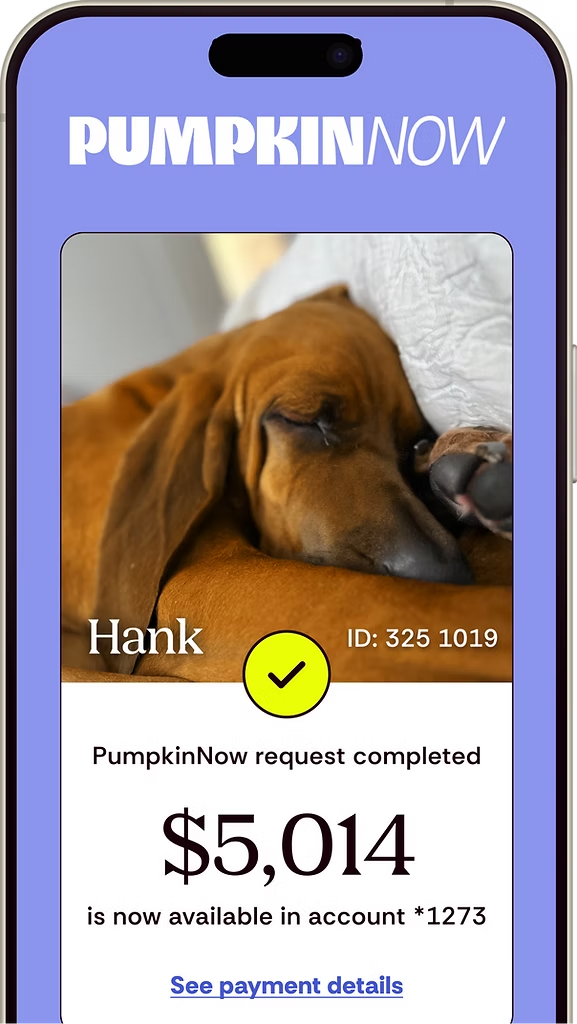
The setup
Pet insurance has trained pet parents to engage with it after the fact. You pay the vet, you submit a claim, you wait three to five business days for reimbursement. The financial backstop arrives after the decision has already been made.
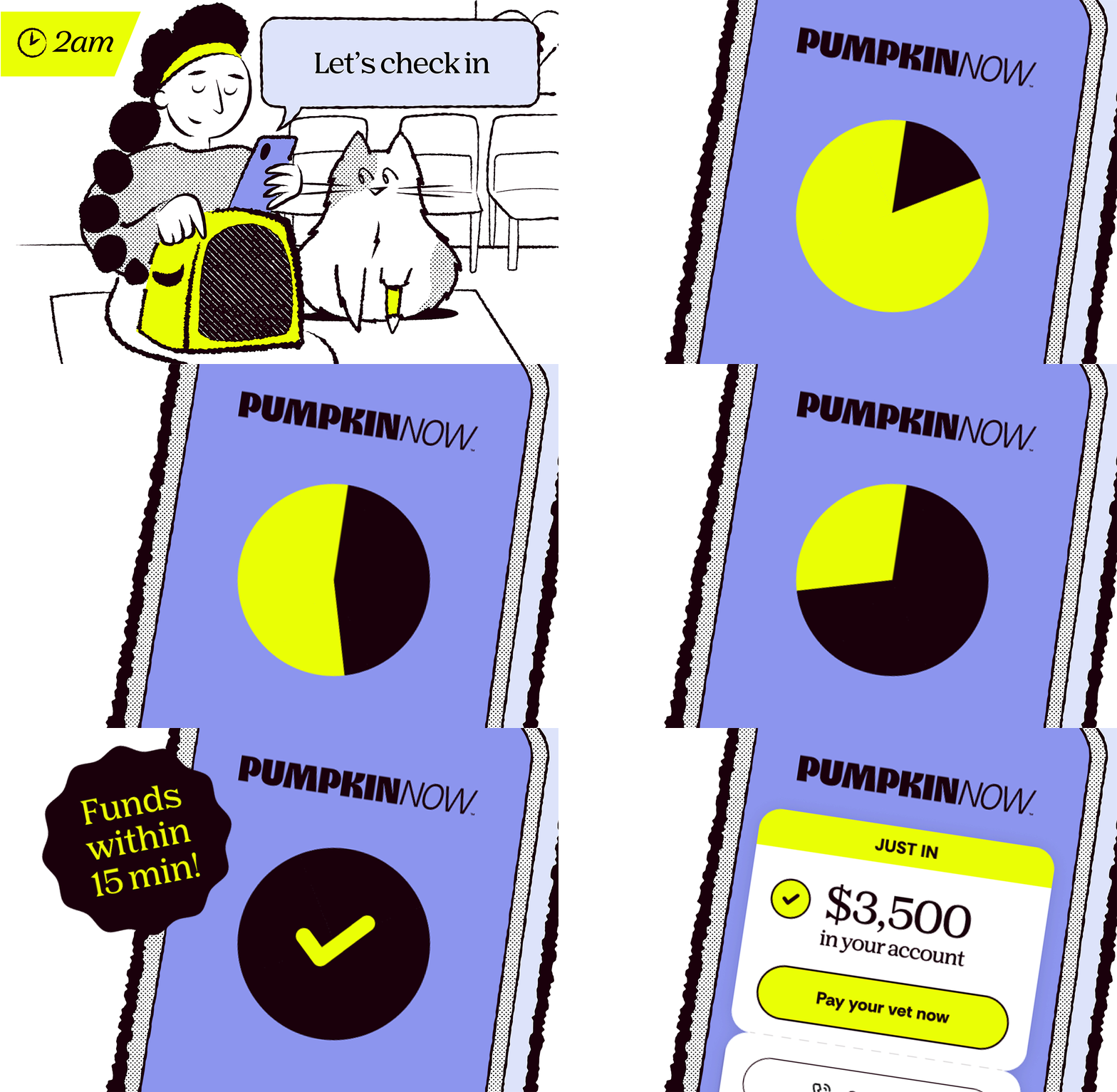
PumpkinNow moves the service to the moment of critical care, where the bill that arrives later is too late.
Contribution
Conceived the service. Led product strategy and service design across the customer submission flow, the vet-facing PawPortal flow, the adjuster decisioning experience, and the launch positioning. Cross-functional with claims operations, engineering, marketing, and actuarial.
Where the pain converges
The vet and the family are in the same moment from opposite sides of the counter. The family is trying to make a treatment decision under pressure. The vet is trying to give them the information to make it without driving them away on price. Both need a financial answer faster than the existing system could deliver one.
PumpkinNow had to be present in that moment, on both sides, with funds and clarity.
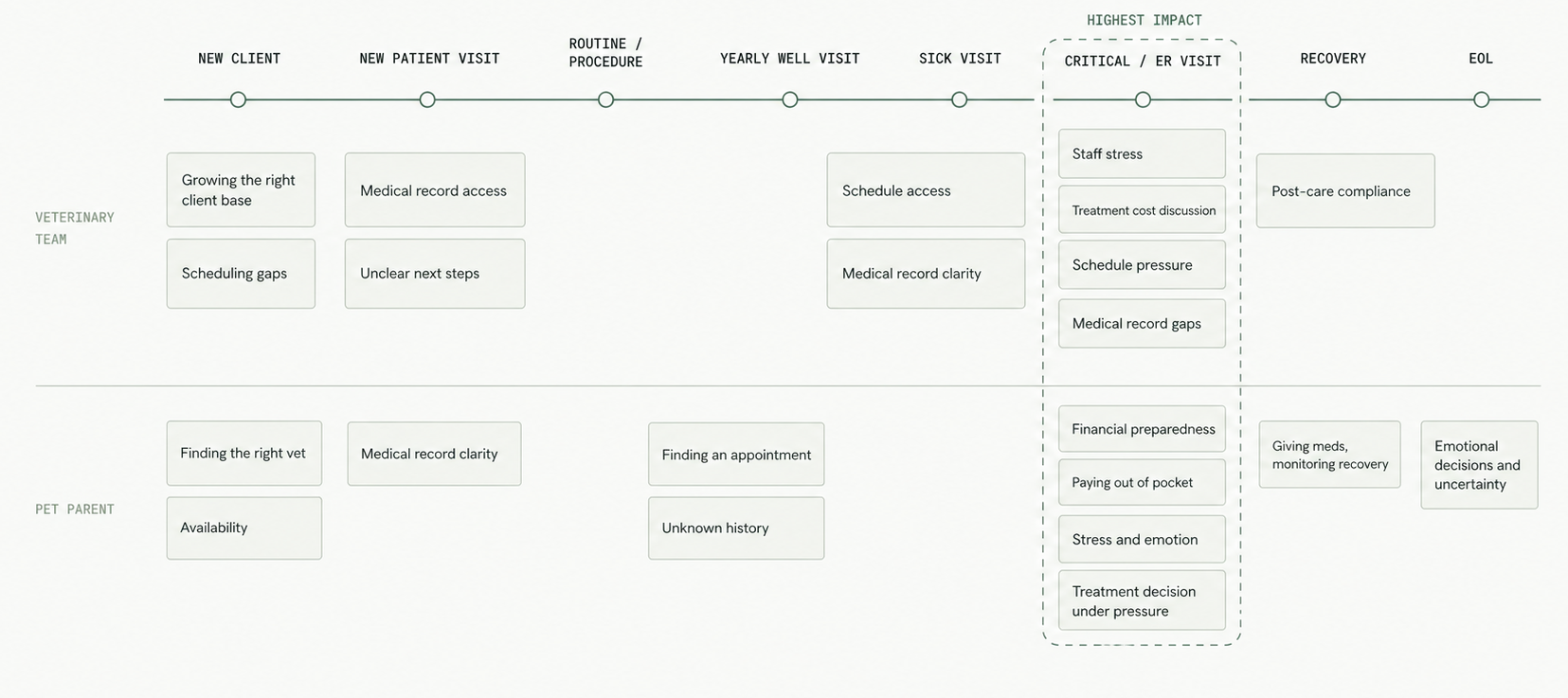
Friction sits on both sides of the counter at every stage. At critical care, it converges.
The trade that shaped the service
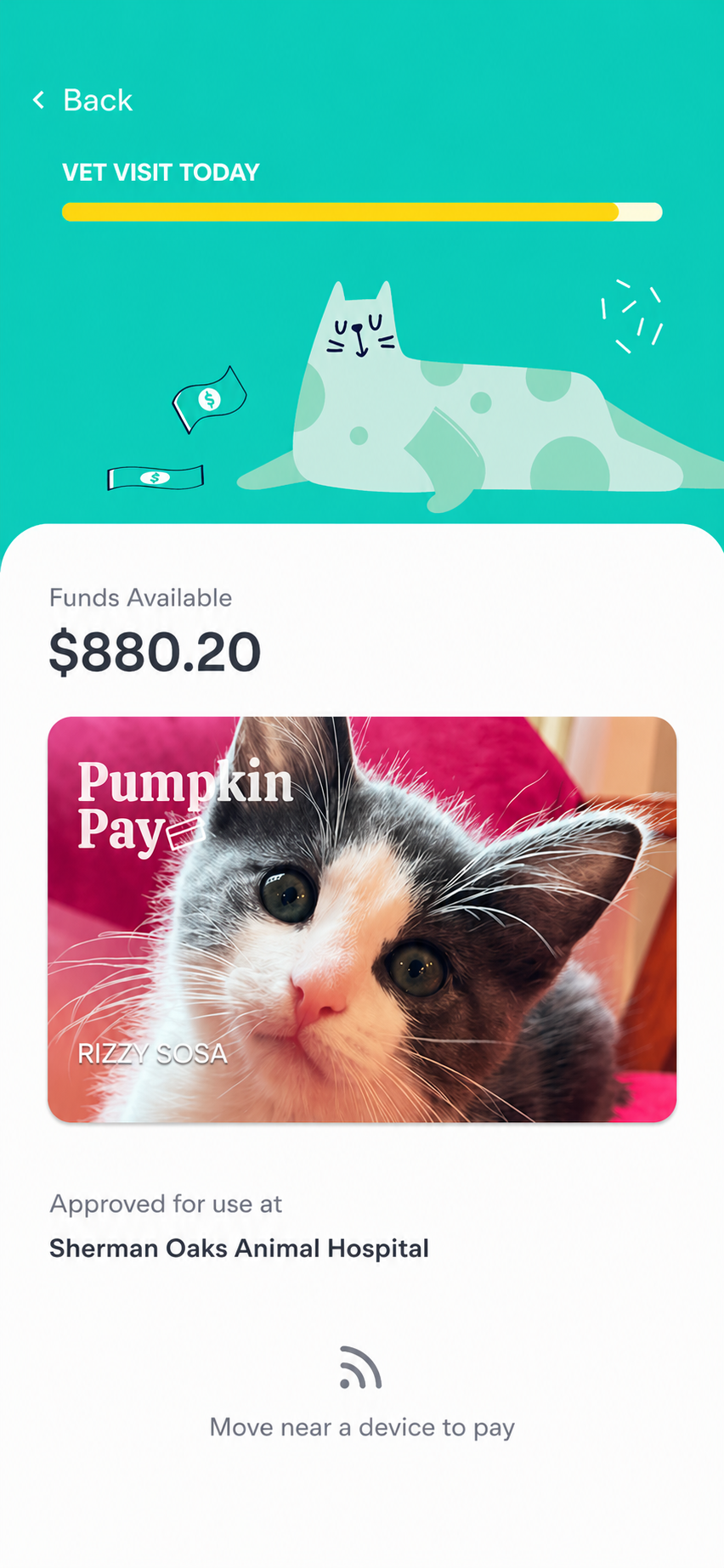
The PumpkinPay card concept.
The vision deck imagined a Pumpkin-branded virtual card: tap at checkout, the funds are already there. A card is a familiar mental model. It would have differentiated Pumpkin in the purchase funnel by itself — a recognizable artifact people could point at and ask for.
We shipped real-time payment rails into the customer's existing bank account instead.
What we gave up
The easiest mental model. A photographable artifact. Differentiation that sells itself in the funnel.
What we got back
A service that shipped in fourteen weeks, reached every Pumpkin customer the day it launched, and worked at any vet without partner contracts or hospital integration.
What it changed about growth
Without a card carrying the explanation in the funnel, growth depended on customers using the service and telling someone. Person-to-person, not point-of-sale.
Delight by design, by constraint.
The 15-minute promise is real when a request routes into the expedited path. The constraint is that not every request can yet: limited hours, pet-readiness gates, bank infrastructure outside our control. So we shaped PumpkinNow as something customers receive when conditions allow, never as something they're told to expect. Every design move below works to keep that posture honest.
Three design moves the service hangs on
01. The system decides, not the customer
A claim is routed the moment it's filed against six factors: type, amount, hours, pet readiness, policy stage, and RTP-bank support. The customer never sees the logic — they file the way they always have.
The hard part was the comms. One submission could become an instant approval, an out-of-hours hold, a deferred standard claim, or a switch from pre-pay to reimbursement. Each path needed its own language, written so the customer understood what was happening without learning the rules behind it.
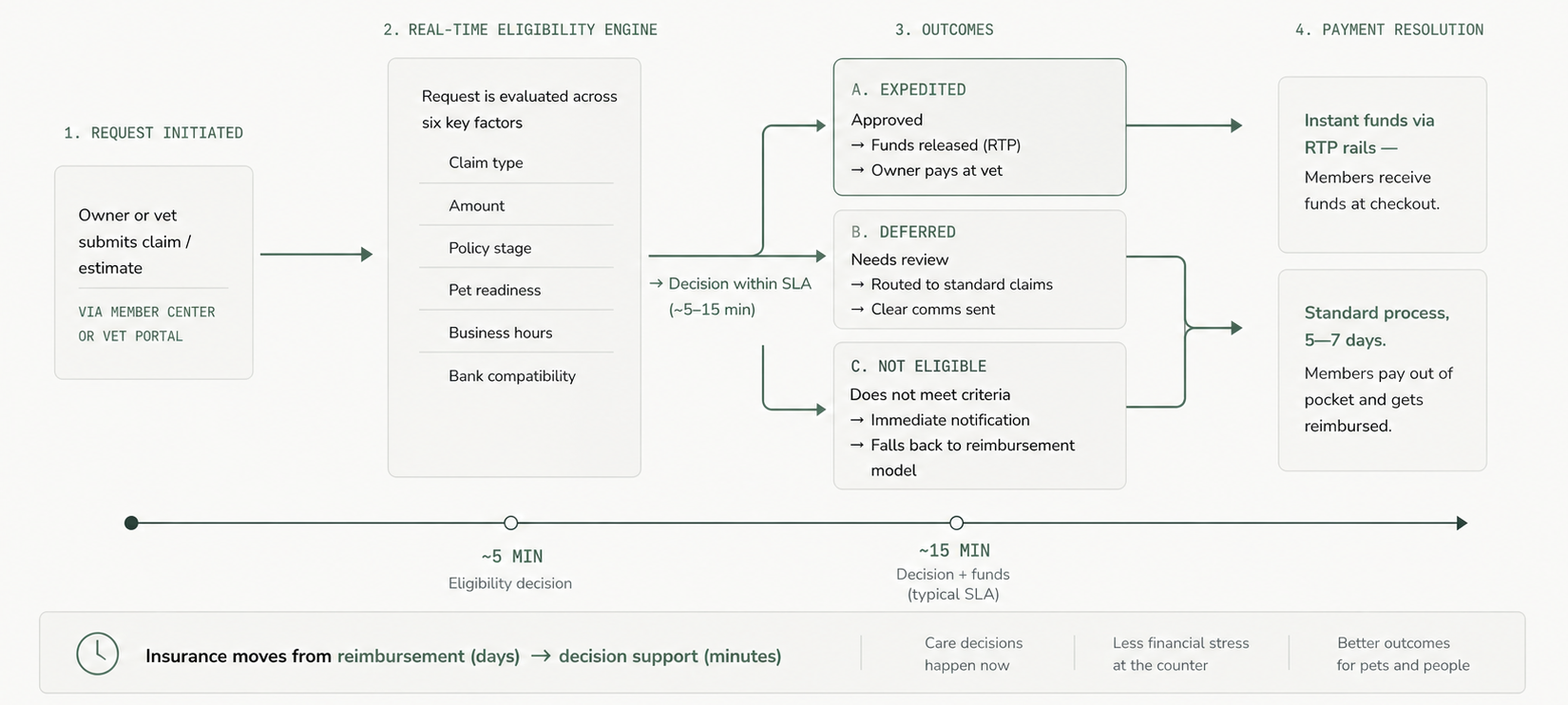
One submission, six factors, three outcomes. The comms surface only what's true for the customer's path.
02. Slow handled honestly
The hardest comms moment isn't the rejection — it's the silence. A customer trying instant-pay for the first time, ten minutes in with no update, gives up on the pattern faster than one told upfront it'll be slow. So the ten-minute idle email matters most.
A request can leave the expedited track at four other moments — a readiness deferral, an adjuster deferral, a carrier-review status change, an out-of-hours hold — each with its own email. The shared principle: explain the wait inside the same envelope as the promise, before the customer has to ask.
03. Distribution by service, not by integration
RTP rails had a downstream effect we didn't appreciate at the start. No card to fund, no merchant restrictions, no fraud surface tied to specific clinics — and so no reason to require partner contracts. Any clinic could participate the day we launched. PawPortal followed from this: a vet who'd never heard of Pumpkin yesterday could file on behalf of a client today.
Distribution was no longer something BD had to negotiate. The rails were the distribution.
What changed
- NPS
- +9pts
- CVR
- +24%
- 4.5 → 4.6
- Trustpilot
- 4.7 → 4.9
- Referrals
- 2.2×
- Median request
- 8.7min
Vet & affiliate channels
Vs. baseline
A card-led launch would have moved different numbers. We pulled the lever we shipped, and it moved review-site ratings, organic referrals, and channel CVR — the metrics a service-led launch is positioned to move.
Learn more about PumpkinNow at pumpkin.care →
Reflection
The open question is what category PumpkinNow becomes when the operational gates are gone. PumpkinPay, the card-led brand vision, is still alive as a future direction. Whether the right next move is to surface PumpkinNow as a customer entitlement, or to ship the card the brand has been waiting for, depends on whether the service has earned enough of the customer's mental model to make the card legible without explanation. I don't think we know yet.
The launch was transitional by design. The service should be a customer entitlement, and it cannot be yet — there are still hours of the week the service doesn't run, still pet-readiness gates that defer requests, still RTP-bank gates outside our control. Once business hours expanded and deferral rates dropped, I'd have surfaced PumpkinNow more directly than we did.
The CVR lift is also messier than the headline number suggests. I can't separate how much came from PumpkinNow itself versus the broader service narrative Pumpkin was building around it during the same period.